Showing posts with label Art. Show all posts

Friday, July 15, 2011

Masterpiece from 15th Century, King Siliwangi Painting And Singabarong Golden Cart

Cirebon, is a city located on the north coast of Java island Indonesia , has many unique cultures and languages, here in this city, Sundanese and  Javanese culture combined, so that the mingling of two cultures, makes its own culture which is a Sundanese and Javanese acculturation.

King Siliwangi Painting
 
Watch the toe it's will follow the direction to someone who stare at the painting

Kingdom of Cirebon is closely associated with the descendants of  King Prabu Siliwangi from Pajajaran kingdom , and the picture here is a painting of King Siliwangi thats an unique masterpiece, because can be viewed in 3D (reminded me of the Mona Lisa painting in the Louvre, France).

Initially after the tour guide explained that this painting can follow the movement of people who saw it, I was a little hesitant, but after I slide to the left and right and watch the eyes movement and direction of his left big toe, I think it is also true, this painting techniques and the selection of his material is definitely very special, so people who see it made as if this painting have the eyes and toes that can be moving following from the sides of the watcher. ..How could this technology like this could be thought by the people who lived in the 15th century?

Golden Cart "Singa Barong"

Anything else makes me more fascinated by the triumph of the Sultanate of Cirebon,is the CART Kencana which is about 5 centuries old, made in 1500s, till this day The cart is still preserved intact in the palace museum.

the cart named Singa Barong has unique and exciting technology, such as body carriage that can swing the shape of the wave path (like suspension on sedan or any modern car), then the wings on side of the cart can flap, and the tongue of lion in front of the cart can protrude in and out.Almost all of the material cart is made of special wood that has been given supernatural powers (according to my guide).

Plus carriage drawn by four buffaloes, have a rear wheel of his fingers into, and sloped, so that when passing through the streets of watery / muddy, do not contaminate the bodyguard who walked behind the train.


I was so impressed, until now I still think and compare, in the 15th century the kingdom architects has been able to think of it, if the cycle goes positive and true civilization, should the people of Cirebon can beat other nations in making the vehicles. this cart also can turn the front wheel in 90 degrees, and some history expert from France and england assume this technology like "power steering" that modern car have.

The Garuda Mina Litter

Then litter to carry princes called Garuda Mina Stretcher, this litter has a head of Eagle and tail Fish named Mina, who has wings on either side.When the litter carried with the prince who resides in a litter, its wings will flapping , so it was like being in a sling eagle that protect him


This very educational philosophy, which heads the Garuda bird teach prince in order to think and act ahead and bring the empire to glory, while the fish has a philosophy that the highest flying, he should remember the fate of people who exist under the oceans or grounded.

So head there may be flying over the air, but should be aware that there are others on the ocean floor. If this philosophy was inherited by both by the leaders of this country, I believe this country will be much more civilized and advanced.

Exchanging souvenirs have become a habit for society since human civilization began, is no exception to the civilization of Europe and the Sultanate of Cirebon. Usually indicates how the souvenirs brought civilization contained in the country of origin, when Europe was on the rise of civilization in art, then the goods produced are similar ceramic products.

In presenting the souvenir items, usually there are also the values ​​that you want to share, as well as ceramic pictures, telling stories about the Prophet in the Gospel .Because the sultanate of Cirebon has converted to Islam, this souvenir remains well received and installed in the reception area of ​​the empire.

Due to unfamiliarity, installation of story in the Gospel is even not consecutive, so installed without a storyline and the relationship between one another.
In addition to ceramics from Europe, there are also ceramics from China, and other objects from India, Gujarat, and Egypt.All this indicates that the Cirebon Sultanate since the former has a relationship with the kingdom and empire in many worlds.Cirebon is gorgeous, a testament to the glory of beautifull people of Indonesia.
Inspired from: www.atmawinata.blogspot.com


The other cart of Cirebon Kingdom


Read More

Wednesday, July 6, 2011

Wayang, The Beautifull Shadow Puppet From Indonesia

Javanese Wayang Kulit (shadow puppet) performance by a famous Indonesian dalang (puppet master) Ki Manteb Sudharsono, is usually a whole night long.Wayang is an Indonesian word for theatre (literally "shadow").When the term is used to refer to kinds of puppet theatre, sometimes the puppet itself is referred to as wayang. Performances of shadow puppet theatre are accompanied by gamelan in Java, and by "gender wayang" in Bali.

UNESCO designated Wayang Kulit, a shadow puppet theatre and the best known of the Indonesian wayang, as a Masterpiece of Oral and Intangible Heritage of Humanity on 7 November 2003. In return for the acknowledgment, UNESCO required Indonesians to preserve their heritage.

History of Wayang Kulit


Wayang Kulit (shadow puppet) in Wayang Purwa type, depicting five Pandava, from left to right: Bhima, Arjuna, Yudhishtira, Nakula, and Sahadeva, Indonesia Museum, Jakarta.

Wayang is a generic term denoting traditional theatre in Indonesia. There is no evidence that wayang existed before Hinduism came to Southeast Asia sometime in the first century CE, brought in by Indian traders. However, there very well may have been indigenous storytelling traditions that had a profound impact on the development of the traditional puppet theatre. The first record of a wayang performance is from an inscription dated 930 CE which says "si Galigi mawayang," or "Sir Galigi played wayang". From that time till today it seems certain features of traditional puppet theatre have remained. Galigi was an itinerant performer who was requested to perform for a special royal occasion. At that event he performed a story about the hero Bhima from the Mahabharata.

Wayang Kulit is a unique form of theatre employing light and shadow. The puppets are crafted from buffalo hide and mounted on bamboo sticks. When held up behind a piece of white cloth, with an electric bulb or an oil lamp as the light source, shadows are cast on the screen.

Wayang Kulit plays are invariably based on romantic tales, especially adaptations of the classic Indian epics, "The Mahabarata" and "The Ramayana". Some of the plays are also based on local happenings (current issues) or other local secular stories. It is up to the conductor or "Tok Dalang" to decide his direction.
A Dalang performing

The Dalang is the genius behind the entire performance. It is he who sits behind the screen and narrates the story. With a traditional orchestra in the background to provide a resonant melody and its conventional rhythm, the Dalang modulates his voice to create suspense thus heightening the drama. Invariably, the play climaxes with the triumph of good over evil.
Wayang Kulit in Java, circa 1890.

Hinduism arrived in Indonesia from India even before the Christian era, and was slowly adopted as the local belief system. Sanskrit became the literary and court language of Java and later of Bali. The Hindus changed the Wayang (as did the Muslims, later) to spread their religion, mostly by stories from the Mahabharata or the Ramayana. Later, this mixture of religion and wayang play was praised as harmony between Hinduism and traditional Indonesian culture. On Java, the western part of Sumatra and some smaller islands traditionalists continued to play the old stories for some time, but the influence of Hinduism prevailed and the traditional stories either fell into oblivion or were integrated into the Hinduistic plays.

The figures of the wayang are also present in the paintings of that time, for example, the roof murals of the courtroom in Klungkung, Bali. They are still present in traditional Balinese painting today.

When Islam began spreading in Indonesia, the display of God or gods in human form was prohibited, and thus this style of painting and shadow play was suppressed. King Raden Patah of Demak, Java, wanted to see the wayang in its traditional form, but failed to obtain permission from the Muslim religious leaders. As an alternative, the religious leaders converted the wayang golek into wayang purwa made from leather, and displayed only the shadow instead of the figures itself.[citation needed] Instead of the forbidden figures only their shadow picture was displayed, the birth of the wayang kulit.[citation needed]

The figures are painted, flat woodcarvings (a maximum of 5 to 15 mm thick—barely half an inch) with movable arms. The head is solidly attached to the body. Wayang klitik can be used to perform puppet plays either during the day or at night. This type of wayang is relatively rare.

Wayang today is both the most ancient and most popular form of puppet theatre in the world. Hundreds of people will stay up all night long to watch the superstar performers, dalang, who command extravagant fees and are international celebrities. Some of the most famous dalang in recent history are Ki Nartosabdho, Ki Anom Suroto, Ki Asep Sunandar Sunarya, Ki Sugino, and Ki Manteb Sudarsono.

Wayang kulit

Wayang Kulit (shadow puppet) in Wayang Purwa type, depicting five Pandava, from left to right: Bhima, Arjuna, Yudhishtira, Nakula, and Sahadeva, Indonesia Museum, Jakarta.

Wayang kulit, shadow puppets prevalent in Java and Bali in Indonesia, are without a doubt the best known of the Indonesian wayang. Kulit means skin, and refers to the leather construction of the puppets that are carefully chiselled with very fine tools and supported with carefully shaped buffalo horn handles and control rods.


The stories are usually drawn from the Ramayana, the Mahabharata or the Serat Menak.

There is a family of characters in Javanese wayang called Punakawan; they are sometimes referred to as "clown-servants" because they normally are associated with the story's hero, and provide humorous and philosophical interludes. Semar is the father of Gareng (oldest son), Petruk, and Bagong (youngest son). These characters did not originate in the Hindu epics, but were added later, possibly to introduce mystical aspects of Islam into the Hindu-Javanese stories.They provide something akin to a political cabaret, dealing with gossip and contemporary affairs.

 Wayang kulit as seen from the shadow side

The puppet figures themselves vary from place to place. In Central Java the city of Surakarta (Solo) and city of Yogyakarta are most famous and the most commonly imitated style of puppets. Regional styles of shadow puppets can also be found in West Java, Banyumas, Cirebon, Semarang, and East Java. Bali produces more compact and naturalistic figures, and Lombok has figures representing real people. Often modern-world objects as bicycles, automobiles, airplanes and ships will be added for comic effect, but for the most part the traditional puppet designs have changed little in the last 300 years.

Historically, the performance consisted of shadows cast on a cotton screen and an oil lamp. Today, the source of light used in wayang performance in Java is most often a halogen electric light. Some modern forms of wayang such as Wayang Sandosa created in the Art Academy at Surakarta (STSI) has employed spotlights, colored lights and other innovations.

The handwork involved in making a wayang kulit figure that is suitable for a performance takes several weeks, with the artists working together in groups. They start from master models (typically on paper) which are traced out onto kulit (skin or parchment), providing the figures with an outline and with indications of any holes that will need to be cut (such as for the mouth or eyes). The figures are then smoothed, usually with a glass bottle, and primed. The structure is inspected and eventually the details are worked through. A further smoothing follows before individual painting, which is undertaken by yet another craftsman. Finally, the movable parts (upper arms, lower arms with hands and the associated sticks for manipulation) mounted on the body, which has a central staff by which it is held. A crew makes up to ten figures at a time, typically completing that number over the course of a week.

The painting of less expensive puppets is handled expediently with a spray technique, using templates, and with a different person handling each color. Less expensive puppets, often sold to children during performances, are sometimes made on cardboard instead of leather.

Source:

Read More

Saturday, June 11, 2011

The Unique Life of Asmat Tribes

keywords: village ,korowai ,westpapua ,tribes ,tree house ,travel ,the village ,senggo ,jayapura ,irian jaya ,indonesia ,dinner ,breakfast ,yali tribe ,woodcarving ,wamena airport ,wamena ,trekking ,timika airport ,timika ,statue ,south coast ,rockefeller ,primitive tribe ,primitive ,papua new guinea ,new guinea ,michael rockefeller ,long house ,kombai ,jungle ,indonesia travel ,headhunting ,head-hunting ,guest house ,flight ,expedition ,carving ,boat ride ,basman ,baliem valley ,asmat region ,asmat regency ,asmat culture ,asmat art ,arrival ,airport ,adventure travel ,adventure tours ,adventure


Asmat is a name of a tribe in Papua. Asmat tribe known as the result of a unique wood carvings. Asmat population is divided in two, those tribe's people living in coastal areas and those living in the hinterland. the two populations are different in the ways of living, and social structure .the population of asmat tribe further divided into two parts, namely Bisman tribes who were among the rivers and streams sinesty nin and spare Shimei.

usually in a village inhabited by approximately 100 to 1000 people. every village had one bachelor house and many family homes. bachelor's house is used for ceremonial and religious ceremonies. family houses inhabited by two to three families, who have their own bathroom and kitchen.

Survival habits and foraging among one tribe with another tribe in the area of ​​District-Mitak Citak was almost the same. Asmat tribal land, tribal and ethnic Mitak citak have a daily habit of making a living by hunting animals in forest such as snakes, cassowaries etc.. they also produce sago as a food staple and the fisherman that is looking for fish and shrimp to eat.

They know the three concepts of the world: Amat ow capinmi (the reality life that happen now), Dampu ow campinmi (the world of spirits who have died), and Safar (heaven). For the sake of saving people and redeem souls, the persons of Asmat tribe who's still alive had to make sculptures and statues, make some party like a bis party(Bioskokombi), masks party, boat party, and sago worm party.

bis statue is the most sacred statue. but now make a statue for the Asmat, not only the call from tradition. because the engraving is also selling them to strangers at a party when carving. they know, the hand-carved that they make its prices between 9 US $ thousand up to hundreds dollars outside papua.

Today, there are approximately 70,000 Asmat people live in Indonesia. Asmat majority of children were at school.


Sometimes we forget the presence of our brothers who were there. they were just like we have the right to nationality. live from us how to try to share to others

Read More

Sunday, June 5, 2011

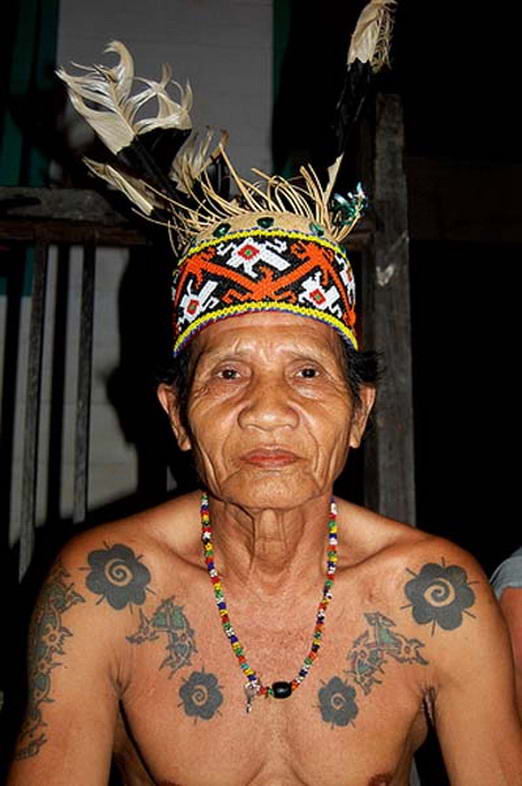
The Essence of Dayak Tattoo

Beside shape of the long ears, the other Dayak tribes tradition is a tattoo. Dayak woman above 40 years old on average have a tattoo on his arm and leg. For women, the presence of tattoos on their bodies showed they were members of noble families. People of Dayak Kenyah , Bahau, Iban, Kayan have tattoos, while the other Dayak groups do not follow this practice.
Tattoo Motives for women Kenyah include dog chains, the motives of the war, the horns of the animals in the arm and thigh, dams circle motifs in the calf or ankle.
Tattoos on Dayak Kenyah tribe is a sign of maturity, while for men the tattoo is a sign that they've explored the other lands and has done something extraordinary, such as killing an enemy in battle.

Sjaifullah and Try Harijono in an article in Kompas, October 22, 2004, entitled “Makna Tato bagi Masyarakat Dayak” said the tattoo for some Dayak ethnic communities are part of the tradition, religion, social status in society, and can also as a form of recognition rate against one's ability.

For this reason, tattoos for the Dayak community can not be made haphazardly. Nevertheless, the religious tattoos have the same meaning in the Dayak community, namely as a "torch" in the course of one's natural to eternity, after death.

Therefore, the number of tattoos that more and more indicative of the growing number of "torch" that will illuminate the way to a natural person immortality but tattoo could not be made as much in vain, because it must comply with customs regulations.

Both tattoos on men and women, traditionally made using orange spines long and gradually then use some needle . What has not changed is the material tattooing which typically uses soot from the pot black. This is what makes tattoo from Dayak different from any other tattoos that often use different colors for beauty reasons.
But unfortunately the Dayak tattoo that was so noble, that describes the "torch" that will light the way to the owner to the nature of eternity, has now shifted its value. Now, no more Dayak tattoos are considered as the symbol for "cool effect", especially for the younger generation.

The presumption tattoo as a symbol of valor is similar to public opinion outside the Dayak, tattoos usually identified with the thugs who can say proudly. This assumption is then penetrated the Dayak youth, through a process of globalization.

Globalization has made the shift into Dayak Tattoos for show and violence only.Only a few parents in the village are still paying attention, as he believes that modernization has weakened the traditional cultural on dayak tattoo aspects
Responding to this, Lawrence Ding Lie, who called himself Art Tattoo Dayak maker in the village of Long Bagun Ilir, expressed concern.

He is concerned with the image of a tattoo that is identical to the violence.
Especially lately more and more non-Dayak want to have Dayak tatto, without knowing the real essence of these Dayak tattoo.
This is very unfortunate, when the cultural values ​​of a culture lost and replaced by another value that can be said to deviate from its original value because the process of modernization and globalization.

Read More

Saturday, June 4, 2011

Bedhaya Ketawang, Mystical Dance With Beautiful Rhytm

Bedhaya Ketawang Dance is a very sacred and is only held once a year. It is said in it danced the Queen of South sea participate on the dance to respect to the successors of the Mataram Kings dynasty.Treasury Beksan (dance) tradition Surakarta Sultanate palace consists of various kinds.
Bedoyo Ketawang (Link)

Viewed from its function, the dance can be divided into 3 types. That dance has magical properties of religious, depicting the war dance, and dance that contains the story (drama).
Each dance is created because there is history that is affected by the atmosphere at that time. Various types of dance created by pengramu keraton (the Palace advisor) it's not he make by him self or imagination, but combined with input from the supernatural creature who has a good relationship with the royal family. So there are loads of mystical and magical.
BEDOYO KETAWANG Link

Dance which has a magical-religious nature, such as Bedhaya usually exhibited by 7 or 9 young lady, while that was exhibited by 4 girls called Serimpi dance.

Dance origins Bedhaya Ketawang 

at first only exhibited by seven women only.In subsequent developments, because this dance is considered a special dance and trusted as a very sacred dance and then was exhibited by nine people.Unlike other dances, this Ketawang Bedhaya special originally demonstrated by palace courtiers Bedhaya Surakarta Sultanate.

Rhythm was audible over entire (smooth) compared with other dance like Srimpi, and in the presentation without keplok-Alok (applause and words or yell)

A Mystical Dance SRIMPI


It is said Bedhaya dance because this dance just follow and flow to the rhythm of gending instrument, like Bedhaya Gending Ketawang Ageng (created by Penembahan Senapati / founder of Mataram Kingdom) Bedhaya Gending Tejanata and sinom (by Sultan Paku buwono IX) Bedhaya pickaxe (By Paku buwono VIII), Miyanggong (by Sultan Paku Buwono IV), Duradasih (By paku Buwono V), etc.
Who was the creator of Bedhaya Ketawang dance itself until now is still confusing.

Video Bedhaya Ketawang Dance original on Mataram Sultan's Inaguration


Bedhaya Pangkur Video


Bedoyo Ketawang dance according to Your majesty Pakubowono X describe the love symbol of Queen of South Sea with Panembahan Senopati, all motion symbolizes the gentle persuasion and flattery lust, though inevitable Sinuhun, Queen of South Sea still begging for him go with him settle at the bottom ocean and rule in Sakadhomas Bale Kencana (Throne are entrusted by King Rama Wijaya on the ocean floor) and there was agreement / Sacred Oath of South Sea Queen and King for first land of Java, which can not be violated by Javanese kings or hereditary kings successor.

One source mentioned that this dance was created by Penembahan Sanapati, first King of Mataram, while meditating on the South Coast. The story tell, in his ascetical Penembahan Senapati met Kencanasari Queen (Queen of South) who are dancing.

Furthermore, the ruler of the South Sea is taught that dance to this Mataram rulers.
Another source mentions that Bedhaya Ketawang dance was created by Sultan Agung Anyakrakusuma (grandson Panembahan Senapati).
According to the Book of Wedhapradangga which is considered the creator of this dance is Sultan Agung (1613-1645), the greatest king of the kingdom of Mataram along Kencanasari Queen, ruler of the South Sea.

The story told, when Sultan Agung was meditating, suddenly heard the strains of a gising. Later the Sultan Agung have an idea to create dance movements adapted to the strains gising that he ever heard.Finally, the dance movements that can be produced with perfect then called Bedhaya Ketawang dance.

Compiled from various sources

Read More

Friday, June 3, 2011

Simple Instrument Music Karinding From Sundanese

Karinding, is the music instrument from Sundanese since 300 Years Ago

Made from old bamboo and dried palm or from the midrib, traditional musical instruments, categorized as a folk instrument is said already exist in the land of Sunda,west java since 300 years ago. Karinding, thus the name of a music tool that can only be played in one key tone.
 "If only the F key then the F course, if the key G yes G alone," said Dadang (42) the Community of Hong in the workshop at the event Karinding Bandung "Kotaku Hijau", Field Tegallega from Saturday-Sunday (2-3/8/2011). If you want to play another tone, continued Dedi, Karinding just need to control the volume air of breathing.
The existence Karinding probably unfamiliar even in Sunda it self. Although age has been past, but the shape and sound still feels strange in the ears of Sundanese people in general.

Karinding has three parts: the needle where the exit tone called cecet ucing (tail cat-ed), then limiting the needle, and the tip called panenggeul (bat-ed). Panenggeul if hit by hand will serve to move the needle. So, come out of Karinding distinctive sound.
In making Karinding through five stages of manufacture to be a Karinding who can really play.

"Of the five Karinding made in one day can obtain one Karinding most appropriate to play music," said Dedi. Karinding also stored in special equipment is also made from bamboo reeds that have air holes.

According to Dedi, Karinding can only be combined with the musical instruments of traditional music such as angklung. "Because Karinding have a light tone and low," he said.

Read More
Plugboard Mania Automatic Backlink Exchange Multiple Backlinks Text Back Links Exchanges Free Automatic Link Unlimited Backlink Unlimited Backlink Exchange Free Backlinks Kostenlose Backlink Austausch Free Automatic Link Free Backlinks calendario-biblico Free Backlinks Exchange Free Automatic Link Free Automatic Link Free Automatic Link Free Automatic Elvira Links Free Automatic Link Free Backlinks Free Backlinks Free Backlinks Unlimited Backlink Exchange Unlimited Backlink Exchange Free Automatic Link Web Link Exchange Text Back Links Exchange Text Back Link Exchange DAHOAM Free Backlinks echange de liens Intercambio gratis de Enlaces Intercambio gratis de Enlaces Unique Culture
Site Meter My Ping in TotalPing.com Google PageRank Checker Powered by  MyPagerank.Net